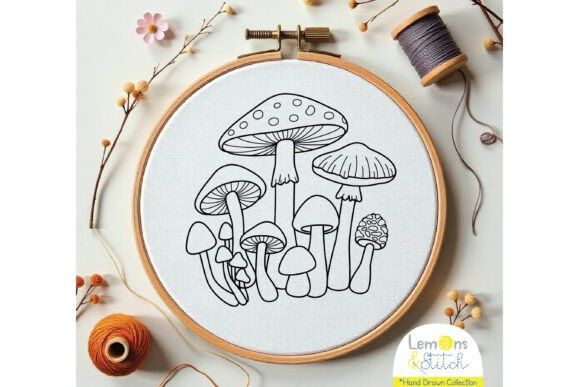
Many Mushrooms Hand Embroidery: A Designer’s Review
As a professional embroidery designer and product reviewer, I approach every new pattern with a critical eye toward its practical application in real-world projects. When evaluating Many Mushrooms - Hand Embroidery, my first thought was not just about the aesthetic charm of the botanical illustration, but how it translates into a tangible, sellable, or giftable item. This is strictly a needlepoint template for hand stitching, and it is vital to note immediately that this pattern is NOT suitable for machine embroidery. For makers accustomed to loading a digital embroidery file and pressing start, this distinction defines your workflow entirely. However, for those dedicated to the slow craft movement, this design offers significant potential for high-value handmade products.
First Impressions and Visual Personality
The visual mood of Many Mushrooms - Hand Embroidery is undeniably rooted in cottagecore and forest aesthetics. The layout feels organic rather than rigid, which is essential when working with natural themes. As a graphic asset intended for print-on-paper transfer, the line work appears clean enough to serve as a reliable guide without being so thick that it obscures delicate stitch work. In my experience reviewing Hand Embroidery Patterns, the success of a mushroom motif often hinges on the balance between cap detail and stem proportion. This design seems to capture that whimsical yet structured look that performs exceptionally well on unbleached cottons, linens, and earth-toned fabrics.
For an Etsy seller or creative entrepreneur, this specific visual personality targets a very engaged niche. Buyers looking for personalized gifts or boutique merchandise are currently favoring designs that feel hand-drawn and authentic over polished, mass-produced graphics. The availability of sizes ranging from 3 inches to 8 inches provides excellent versatility, allowing you to scale the project from a subtle pocket accent to a statement piece on home decor.
Real-World Application: Stitching a Custom Tote Bag
To truly evaluate this pattern, I mentally mapped it onto a current client request: a custom embroidered tote bag for a local farmers' market vendor. This scenario tests the design's durability, visibility, and commercial appeal. Using the 6-inch version of Many Mushrooms - Hand Embroidery, I envisioned placing the cluster slightly off-center on a heavyweight canvas tote.
In this context, the design shines because hand-stitched mushrooms allow for texture variation that a machine cannot easily replicate. I would utilize a combination of long and short stitch for the caps to create shading, while employing stem stitch or split stitch for the stalks to maintain definition against the coarse fabric texture. Because this is a needlepoint template adapted for surface embroidery, the open nature of the design prevents the canvas from puckering—a common issue with dense fill stitch areas in machine embroidery. For a small shop product, this tactile quality signals "premium" to the customer. It transforms a standard tote bag design into a piece of wearable art that justifies a higher price point than generic printed alternatives.
Navigating Fabric Choices and Technical Constraints
While the design is versatile, it requires careful consideration of substrate. Since Many Mushrooms - Hand Embroidery relies on the precision of hand-guided stitches, fabric choice dictates the final clarity. I strongly advise testing this pattern on scrap fabric before committing to a finished product, especially if you are selling commercially.
- Textured Fabrics: On linen or burlap, the organic lines of the mushrooms blend beautifully. However, ensure your thread colors have high contrast against the weave so the details do not get lost.
- Stretchy Knits: If applying this to sweatshirt embroidery or baby clothes, you must use appropriate stabilizer. Hand stitching on knit without stabilization will distort the mushroom shapes. Consider using a water-soluble topping to keep stitches sitting on top of the pile.
- Dark Fabrics: The pattern comes on letter-size A4 paper. If transferring to dark material, verify that your transfer method (chalk pencil, white carbon paper, or prick-and-pounce) leaves visible guidelines. Invisible lines lead to frustrated stitching and uneven results.
- Small Hoop Sizes: While available in 3 inches, intricate mushroom gills or tiny accent elements may become difficult to render cleanly at the smallest scale. Inspect small details closely; if they require fewer than two strands of floss to be legible, consider sizing up to at least 4 or 5 inches for better stitch clarity.
Conversely, avoid using this specific hand-stitching template on curved surfaces like caps unless you are highly experienced. The flat paper template does not account for the curvature of a hat brim, which can distort the perceived proportions of the mushrooms during the transfer process. For caps, a digital embroidery file designed specifically for cylindrical hooping is usually a safer bet for commercial consistency.
Commercial Viability and Brand Consistency
For craft business owners and apparel decorators, integrating Many Mushrooms - Hand Embroidery into a product line requires thinking about brand consistency and production time. Hand embroidery is inherently slower than machine production. Therefore, this design is best positioned as a limited edition offering, a premium upgrade, or a signature collection piece rather than a high-volume staple.
When creating printable mockups or digital product previews for your online store, photograph the actual stitched sample rather than relying solely on the digital graphic. Customers need to see the stitch density and thread sheen to understand the value of a handmade product. The organic imperfection of hand-stitched mushrooms builds trust and recognition; it proves human involvement. If you plan to use this for holiday embroidery or wedding gifts, emphasize the customization potential. Perhaps each mushroom cap could feature a different color representing family members, or initials could be subtly integrated into the foliage. This level of personalization is where hand embroidery outperforms automated alternatives.
Designer Notes for Professional Results
Before listing any finished product derived from Many Mushrooms - Hand Embroidery, conduct a thorough technical review. Confirm licensing terms regarding commercial use of the pattern itself versus the sale of the physical embroidered item. Always check whether the design works for both personal and commercial projects to protect your business legally.
Pay close attention to thread color contrast and stitch density. Unlike a satin stitch in machine embroidery which covers ground quickly, hand embroidery requires deliberate coverage planning. Test your chosen palette in black and white photos to ensure values read correctly; sometimes vibrant reds and greens appear muddy in low-light product photography. Additionally, consider the end-use care. If this design is applied to tea towels or baby items that require frequent washing, secure all knots meticulously and use colorfast threads. Avoid decorative accents that might snag. Finally, remember that while this is categorized under Graphics for purchase, its true value lies in its execution as a textile art piece. Treat the paper pattern as a blueprint, but let your needle and thread dictate the final character of the work. By respecting the limitations and strengths of this hand-stitching template, you can create commercial embroidery projects that stand out for their quality, intentionality, and genuine handmade appeal.